
The Legal Entity Identifier (LEI) is used in regulatory reporting and increasingly in business processes beyond regulation. Its value depends on the system behind the record: accredited issuers, verification against authoritative sources, daily data quality checks by GLEIF and annual revalidation. Because LEI records are published openly, banks, KYB providers and trade platforms can use the same standardised entity data in their own processes.
Who verifies an LEI, and how
Only organisations accredited by the Global Legal Entity Identifier Foundation (GLEIF) can issue LEIs. Accreditation ends in a binding Master Agreement, and through its Annual Accreditation Verification GLEIF re-checks each issuer’s internal controls every year. Issuers must evidence continued compliance to keep their accreditation.
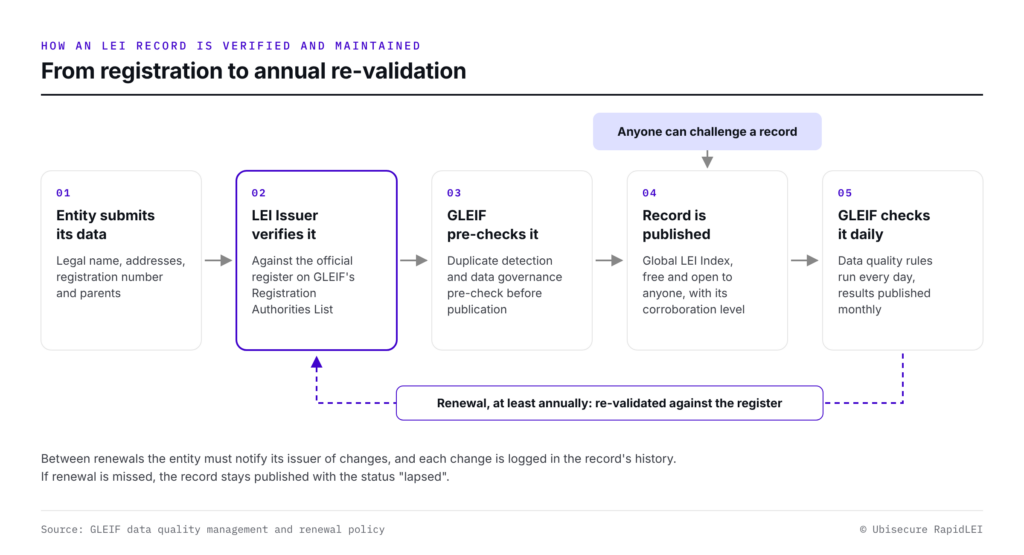
The entity supplies its own data when it registers. The issuer must verify that data against an authoritative source, typically the national business register, before the LEI is published. GLEIF’s Registration Authorities List standardises those sources: more than one thousand registers, each with a code recorded on the LEI.
Those sources are not always free. Under its 2026 tariff schedule, the Dutch Chamber of Commerce (KVK) charges €9.60 for a digitally certified extract from its business register and €19.20 for a certified paper extract. Open data has narrowed the gap: the EU’s High-Value Datasets Regulation requires company data to be published free of charge via APIs, and Finland has made electronic trade register extracts free since August 2022. Free data and official evidence can still be separate products. KVK says its free open dataset is intended for reuse and not as a means of legal certainty, while its certified extracts remain chargeable. For an LEI Issuer, the evidential status of a source matters as much as its availability, because the issuer must be able to show what it checked.
Every record then states how much of it the issuer could confirm:
- Fully corroborated: all reference data has been validated against public authoritative sources.
- Partially corroborated: at least one data element could not be validated against a public source. The label does not say which, so a user relying on a specific field, such as the registered address, should check that field directly.
- Entity-supplied only: the data is supported only by documents provided by the entity. This is common for trusts and funds without a public register, where the trust deed is often the only source.
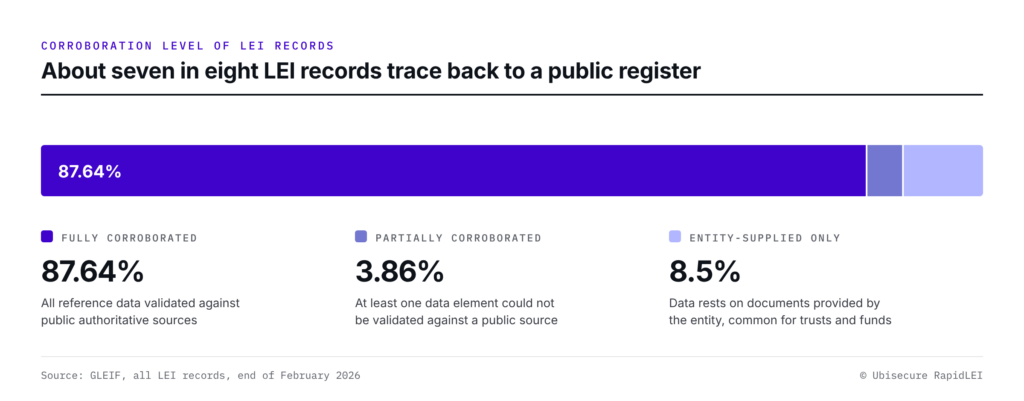
At the end of February 2026, 87% of records were fully corroborated, almost 4% partially corroborated and 8.5% entity-supplied only. The corroboration label helps users judge the evidence behind a record and identify where they may need to verify individual fields.
Full corroboration covers the reference data on the record: legal name, addresses, registration number and legal form. It says nothing about what the entity does, who ultimately owns it, or whether it is in good standing with anyone. GLEIF also checks the label itself. If a record claims full corroboration but its Registration Authorities List code is missing or wrong, GLEIF’s checks fail and the issuer must correct it.
How LEI data is maintained
Before publication, each record passes GLEIF’s duplicate detection and data governance pre-check. After publication, it is checked daily against GLEIF’s data quality rules, with results published monthly. Anyone with evidence can challenge a record, and the managing issuer must resolve it with the entity. In August 2026, GLEIF logged 4,546 new challenges, and challenges closed that month took five days on average.
Annual renewal provides a further check. GLEIF defines it as re-validating the reference data against a third-party source, and the LEI Regulatory Oversight Committee requires it no later than one year after the previous verification. Between renewals, the entity must notify its issuer of changes, and each change is logged in the record’s history.
Renewal and changes serve different purposes. A renewal often confirms that nothing has changed: the next renewal date moves forward and the data stays the same. A change, such as a new address, appears as a logged event with its own effective date. A user needs both. The renewal tells you the data was checked recently; the event history tells you what has changed and when.
If an entity does not renew, its record stays published with the status “lapsed”, meaning the data has not been re-validated on schedule. In September 2026, GLEIF’s statistics showed 3.19 million LEIs for entities still recorded as operating. Of those, 1.98 million were issued and 1.2 million had lapsed, more than a third. Lapsed describes the registration, not the entity: the business may be trading normally while its LEI data goes unchecked.
Since April 2024, each record has also carried a Policy Conformity Flag. A record is conforming when its registration is current and its Level 2 reporting is complete, meaning the entity has reported its direct and ultimate accounting parents or an accepted reason for not doing so. The flag tests those two conditions only.
How LEIs support KYB
The LEI can support KYB in two ways. A firm can use an existing LEI to retrieve verified entity data, or it can obtain an LEI for a client as part of its own onboarding.
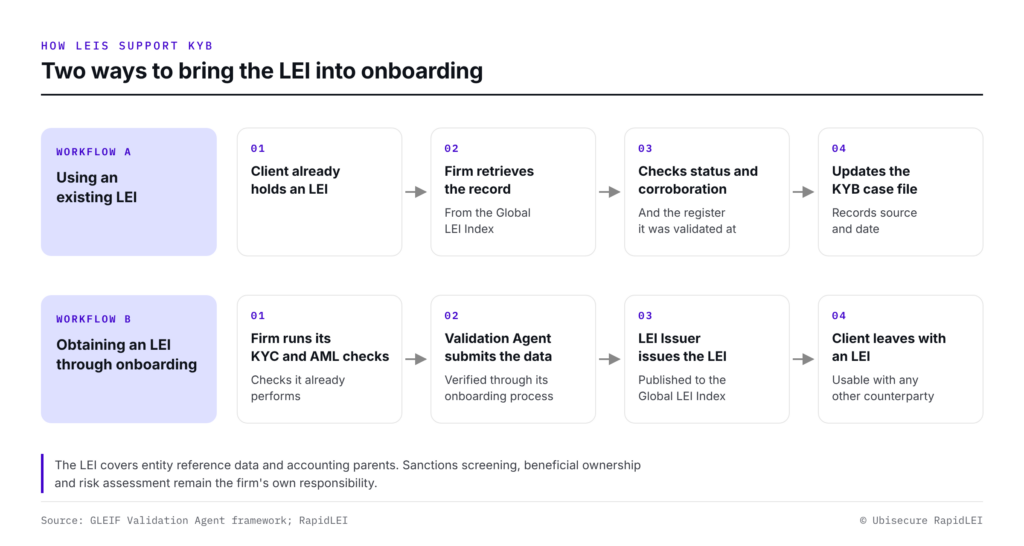
Using an existing LEI. Take a bank onboarding a Luxembourg fund. Without an LEI, its onboarding team orders a register extract, keys in the fund’s name and address, and repeats the exercise at each periodic review. With an issued, fully corroborated LEI, it pulls the same data from the Global LEI Index, sees which register it was checked against and when, and spends its time on the questions the LEI does not answer.
Obtaining an LEI through onboarding. Under GLEIF’s Validation Agent framework, banks and KYB providers use the KYC and AML checks they already perform to obtain LEIs for clients, during initial onboarding or a standard client refresh. The client leaves onboarding with an LEI it can use when dealing with other counterparties, and the entity enters the Global LEI System. Vivid Money, confirmed by GLEIF as a Validation Agent in November 2025, does this for its SME and freelancer clients in partnership with RapidLEI. RapidLEI has launched the majority of GLEIF’s Validation Agents.
Keeping case files current. Entity data in a due diligence file drifts after onboarding: an address changes, a name is updated, a parent is acquired. A bank that holds a client’s LEI can treat the LEI cycle as a scheduled source of re-validated reference data. At each renewal or logged change, the analyst updates the case file from the current record and notes the register and date it was checked against. A bank can use the LEI record to maintain reference data in its case files, but the LEI does not determine how frequently the bank reviews a client. That remains a risk-based decision. If an LEI lapses, the bank needs another source to verify the data until the record is renewed.
An LEI verifies an entity’s identity and records its accounting parent relationships. It does not screen for sanctions, identify individual beneficial owners or assess risk. Organisations must continue to perform those checks under their own controls
Where the LEI is used beyond regulation
- Modelled savings. McKinsey research for GLEIF in 2019 estimated that wider LEI use could save banks $2-4bn a year in client onboarding and cut 3 to 7 days from time to revenue. These are estimates of potential savings, not measured results, and they predate most Validation Agent adoption.
- Announced collaborations. In February 2026, GLEIF and AEOTrade signed a memorandum of understanding to explore using the vLEI, the cryptographically verifiable form of the LEI, to verify the parties to electronic bills of lading on AEOTrade’s trade platform. The agreement is at an early stage; both parties say the focus is on developing real-world use cases.
- The winner of GLEIF’s December 2025 vLEI hackathon, MSC Trustgate, built a document-signing portal that checks a vLEI credential to confirm both who is signing and their authority to act for the organisation, then binds those checks to a standard digital signature. The prototype demonstrates how a vLEI could help verify signatories and their authority during contract signing.
Check an LEI record yourself
The free RapidLEI LEI Search connects directly to the Global LEI Index. No account is needed.
- Search by company name, LEI number, ISIN or BIC.
- Open the record and check the registration status first.
- Check the corroboration level and the register the data was validated against.
- Note the next renewal date and any logged events.
RapidLEI’s own operating entity, Ubisecure Oy (LEI 529900T8BM49AURSDO55), shows how this works in practice. Its record on 27 October 2026:
| Field | On this record | Use it to decide |
Registration status | Issued | Whether the data has been re-validated on schedule. If lapsed, use another source. |
Corroboration level | Fully corroborated | Whether you can rely on the reference data or need to check individual fields yourself |
Validated at / as | Finnish Patent and Registration Office (RA000188), 1748721-4 | Where to go if you need an official extract |
Next renewal date | 28 June 2027 | When the record is next due for re-validation, and when to refresh your case file |
Policy Conformity Flag | Conforming | Whether Level 2 parent reporting is complete |
The record also logs a June 2024 address change, recorded against supporting documents. Nothing on it addresses sanctions exposure, beneficial ownership or risk; those remain for the user to establish.
Trust starts with verification
An LEI draws on a global system of accredited issuers, authoritative sources and ongoing data quality checks. For banks, suppliers and other organisations, it provides standardised entity data with a transparent verification history and a reliable starting point for due diligence. Each organisation remains responsible for assessing ownership, sanctions exposure and risk according to its own requirements.
Check an entity’s record using LEI Search, or register an LEI in minutes.
Frequently asked questions
How is LEI data verified? The accredited LEI Issuer checks the data supplied by the entity against an authoritative source, usually the national business register, before publishing it. The issuer re-validates the data at least once a year at renewal, and GLEIF runs automated quality checks on every published record daily.
What does “fully corroborated” mean on an LEI record? All the entity’s reference data, such as legal name, addresses and registration number, has been validated against public authoritative sources. It does not cover ownership, activities or risk. Records can also be partially corroborated, or entity-supplied only where no public source exists.
Can I rely on an LEI for KYB? An LEI provides independently verified entity reference data and accounting parent information, which can replace manual register lookups at onboarding. Validation Agents can also obtain LEIs for clients through their own KYB checks. The LEI does not cover sanctions screening, beneficial ownership or risk assessment, so it supports KYB without replacing it.