
Banks, brokers, auditors and trading counterparties regularly ask an entity to evidence its LEI. The usual response is a screenshot of the Global LEI Index or a PDF someone has generated from public data. Anyone can produce either, and anyone can edit either.
Now, every entity whose LEI is managed by RapidLEI can order an LEI Certificate: a PDF attesting to the LEI record, electronically sealed by RapidLEI as the LEI Issuer that validated the entity and publishes its record to the Global LEI Index.
What the LEI Certificate contains
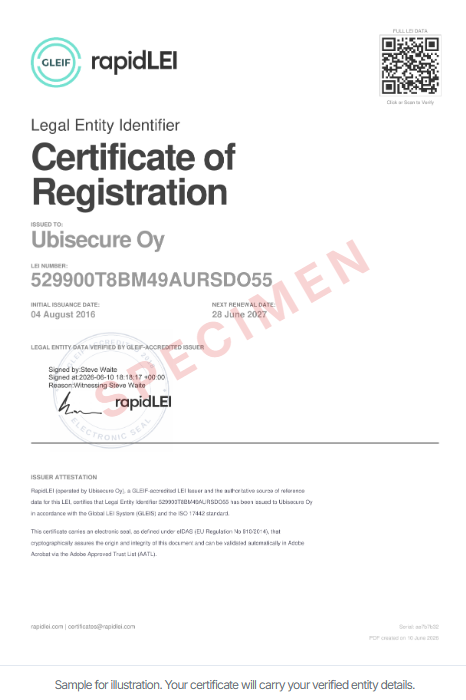 The certificate confirms the entity’s reference data and the status of its LEI at the moment of issue, including legal name, jurisdiction, legal form, registration and renewal dates, and LEI status. Each certificate also carries:
- RapidLEI’s electronic seal under eIDAS, applied with a signing certificate on the Adobe Approved Trust List
- a unique certificate number and issue date
- a QR code linking to the live LEI record, so a relying party can check current status in seconds
Certificates are delivered by email as a PDF, usually within minutes of payment. The price is €10, $12, £8 or ₹1,000 per certificate.
Why the attestation should come from the LEI Issuer
LEI data is public. Anyone can search the Global LEI Index and render a record as a PDF. Those documents restate public data. The LEI Issuer that manages the record is in a different position. It verified the entity against the relevant registration authority, published the record, and revalidates it at each renewal. A statement about the accuracy of the record and the status of the LEI carries most weight when it comes from that party, which is why RapidLEI issues certificates only for LEIs it manages.
Other accredited LEI Issuers have reached a similar view. KDPW made a downloadable registration certificate available to its LEI holders in February 2025, and Bloomberg introduced one in December 2025, describing it as evidence of registration for regulatory reporting, onboarding and transactions. RapidLEI’s certificate carries an eIDAS electronic seal that any relying party can validate in standard PDF software, confirming who issued the document and that it is unchanged.
What the seal does
eIDAS defines an electronic seal as data in electronic form attached to, or logically associated with, other electronic data to ensure its origin and integrity (Article 3(25)). Under Article 35(1), an electronic seal cannot be denied legal effect or admissibility as evidence in legal proceedings solely because it is in electronic form or does not meet the requirements for qualified electronic seals.
In practice, the recipient opens the PDF in Adobe Acrobat or Reader and the signature panel confirms two things: who issued the document, and that it has not been altered since it was sealed. Because the signing certificate chains to the Adobe Approved Trust List, the recipient does not need to install or import anything. Any change to the sealed content causes the signature to show as invalid. Some PDF viewers, including browser previews, do not display signature status, so relying parties should validate in Acrobat or Reader.
The seal is applied in the name of Ubisecure Oy, the company that operates RapidLEI. This is the same entity the Global LEI Index lists as the managing LEI Issuer for every RapidLEI record, so the signature panel and the record match.
How to use your RapidLEI LEI Certificate
Counterparty onboarding. Take a Luxembourg-domiciled fund opening an account with a new prime broker. The broker’s onboarding team asks for evidence of the fund’s LEI alongside the constitutional documents. The fund administrator orders a certificate and attaches it to the onboarding pack. The broker’s analyst validates the seal in Reader, scans the QR code to confirm the LEI is still issued, and files the PDF to the client record.
Customer due diligence records. Under the EU Anti-Money Laundering Regulation, obliged entities identifying a legal entity customer must obtain, where available, its registration number, tax identification number and LEI (Regulation (EU) 2024/1624, Article 22(1)(b)). The Regulation applies from 10 July 2027. Verification remains the obliged entity’s responsibility, and the electronic routes in Article 22(6) refer to eIDAS identification means at “substantial” or “high” assurance and relevant qualified trust services.
RapidLEI’s seal is not a qualified trust service, so the certificate supports the customer file without serving as a verification means in its own right. What it adds is a record of the LEI and its status whose origin and integrity can be checked, which a screenshot cannot offer. Our AMLR spotlight covers the wider LEI requirements.
Own records and audit. Suppose a group company secretary needs to show the auditor that every subsidiary held an issued LEI at the balance sheet date. Ordering a certificate for each entity as part of the year-end close gives the auditor a sealed, dated record per entity, with no screenshots or manual cross-referencing. Timing matters: a certificate ordered weeks later attests to status on the day it was issued.
The LEI Certificate is an attested point in time
An LEI can lapse the day after a certificate is issued if it is not renewed, and entity data can change. The QR code exists for this reason: anyone relying on the certificate for an ongoing obligation should check current status in the Global LEI Index at the point of reliance.
The certificate also does not replace an obliged entity’s own verification judgement, and it does not carry the Article 35(2) presumption of integrity and origin reserved for qualified electronic seals. For automated, machine-to-machine verification of an organisation and the people who act for it, the vLEI is the appropriate instrument. The LEI Certificate meets a different need: a human-readable document that a counterparty, auditor or onboarding team can open, verify and file today.
Who can order
LEI Certificates are available for any issued LEI managed by RapidLEI. If your LEI has lapsed, renew it first, then order your certificate. Enter the 20-character LEI on the LEI Certificate page to begin. If your LEI is managed by another LEI Issuer, you can transfer it to RapidLEI within GLEIF rules with no gap in coverage, then order your certificate.
Order your LEI Certificate or transfer your LEI to RapidLEI.
Frequent Asked Questions
What is an LEI certificate?
An LEI certificate is a document confirming an entity’s LEI and its reference data at a point in time. A RapidLEI LEI Certificate is a PDF issued by the LEI Issuer that manages the record. It is sealed under eIDAS so its origin and integrity can be checked, and it carries a QR code linking to the live record in the Global LEI Index.
Who can issue an LEI certificate?
Anyone can generate a PDF from public LEI data. Only the LEI Issuer that manages the record has validated the entity and maintains its data. RapidLEI issues certificates only for LEIs it manages.
How do I verify a RapidLEI LEI Certificate?
Open the PDF in Adobe Acrobat or Reader and check the signature panel. It shows who sealed the document and whether it has changed since sealing. Then scan the QR code to confirm the LEI’s current status in the Global LEI Index.
Is an LEI certificate the same as a vLEI?
No. An LEI certificate is a human-readable PDF attesting to the LEI record at the moment of issue. A vLEI is a digitally verifiable credential designed for automated verification of an organisation and the people who act for it.
References
-
- European Union, Regulation (EU) No 910/2014 on electronic identification and trust services (eIDAS), 23 July 2014, as amended by Regulation (EU) 2024/1183
- European Union, Regulation (EU) 2024/1624 (Anti-Money Laundering Regulation), 31 May 2024
- Adobe, Adobe Approved Trust List
- GLEIF, Global LEI Index search
- RapidLEI, LEI Certificate