
LEI Search
An LEI search is a query to the Global LEI Index to find and verify a legal entity’s identity, registration status and ownership structure. Search by company name, LEI number, ISIN or BIC across 3.2m+ records. No registration is required and results are interpreted in plain language.
Enter up to 20 LEI codes, one per line. Results include entity name, status, next renewal date, and current issuer.
Powered by RapidLEI: the world’s largest GLEIF-accredited LEI issuer. 3.2m+ records as of Q3 2026 (source: GLEIF). The LEI search and lookup tool covers all 200+ jurisdictions in the Global LEI Index, including the United States, United Kingdom, European Union member states, India, Australia, Canada, and more.
Every LEI record is interpreted and explained
An LEI record answers four questions: who the entity is, who verified its data and when, whether the registration is maintained, and who owns it or why no owner is named. The raw fields state this in GLEIF’s very specific terms: LAPSED, ENTITY_SUPPLIED_ONLY, NON_PUBLIC. Reading them correctly takes knowledge of GLEIF’s rules.
RapidLEI’s LEI lookup interprets the full GLEIF record and states the position in plain language.
In the results list: a one-line summary beneath each entity (“Valid and conforming · RapidLEI”), the next renewal date with days remaining, amber inside thirty days, and an action only where the record needs one.
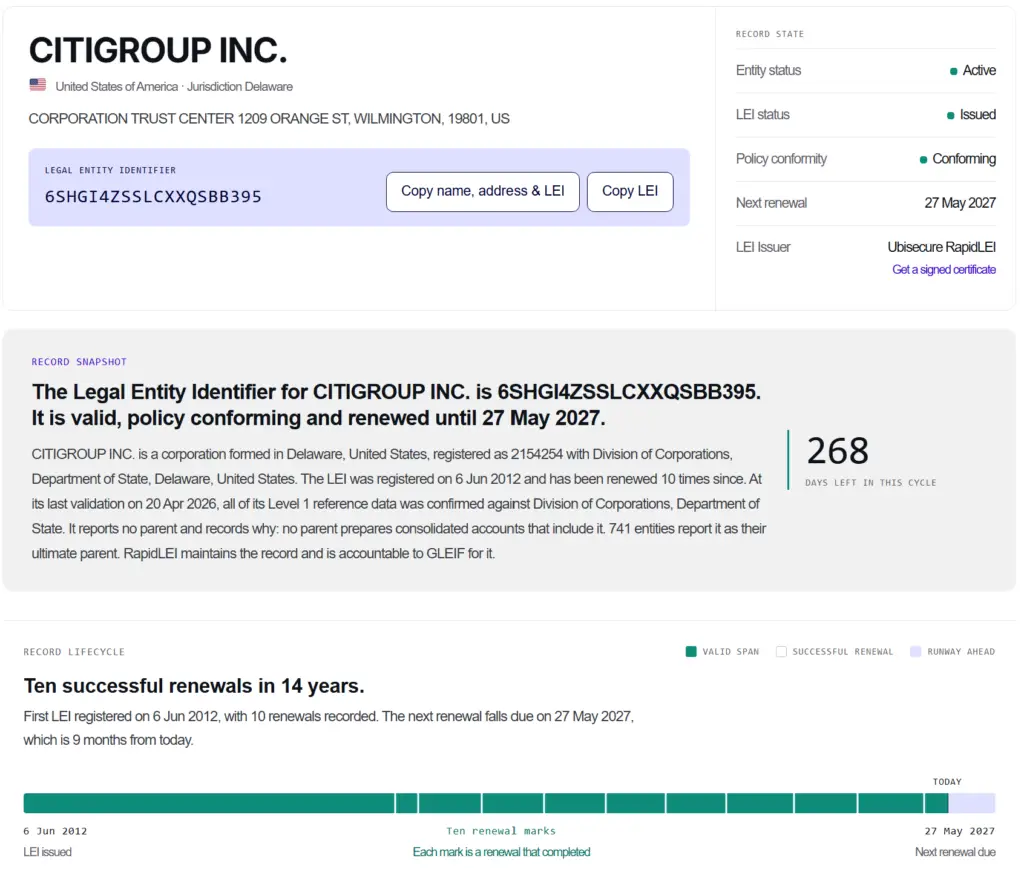
On the record page: a Record Snapshot stating where the entity is registered and under what number, when the LEI was issued and how it has been maintained, which register the data was last checked against and on what date, and what the record reports about ownership.
For KYB and counterparty identification this shows, at a glance: register-verified or entity-supplied data, current or lapsed maintenance, and whether “no parent reported” means the entity stands alone or has an undisclosed owner. The same summaries are published in each page’s structured data, so connected systems read the identical position.
Each record page generates the organisation’s website markup. The LEI structured data guide explains where to put it.
Frequently checked LEI records
- UBISECURE LIMITEDUnited Kingdom
- Bloomberg Inc.United States
- GOLDMAN SACHS (MALAYSIA) SDN. BHD.Malaysia
- ANTHROPIC, PBCUnited States
- 杰润(中国)商贸有限公司China
- J.P. Morgan Cayman Trust Company LimitedCayman Islands
- PLATINUM HOME CARE LIMITEDIreland
- BIG OAT PTY LTDAustralia
- EOS ATLAS INFRASTRUCTURE AND GREEN TRANSITION FUNDLuxembourg
- HIGH SPIRITZ AMARAVATHIIndia
- Frykstrand Ångström ABSweden
- CARZIQO CAR RENTAL SERVICESPhilippines
- HONG KONG HOUSING SOCIETY -THE-Hong Kong
- Ubisecure OyFinland
- Rolf Andersson Dataconsult ABSweden
- ブルームバーグ トレーディング サービス ジャパン株式会社Japan
Use the free LEI search tool in easy steps
How to check legal entity information
-
Enter your search
Type a company, fund or trust name, or an LEI, ISIN or BIC. The identifier type is detected for you.
-
Review the results
Each entity shows country, LEI, next renewal date, days remaining, and whether the LEI is valid, lapsed or retired.
-
Open the full record
Level 1 and Level 2 reference data, registration and renewal history, connected identifiers, and JSON export.
-
Take action
Transfer, renew or reactivate a lapsed LEI, or obtain a digitally signed e-seal LEI Certificate.
Ways to use LEI search
Company Name
Search by registered legal name. Used for due diligence and KYB checks.
Funds & Trusts
Search by fund or trust name. Used in fund and trust compliance verification.
LEI Number
Lookup a 20-character LEI code to retrieve the exact entity record.
ISIN
Find the LEI linked to a securities identifier for MiFID II reporting.
BIC Code
Look up by SWIFT/BIC identifier used in financial transactions.
What does an LEI Number Record show
Two layers of verified legal entity data
Level 1 data: Who is who
- Legal name and other registered names
- Registered address and headquarters address
- Country and jurisdiction of incorporation
- Local business registry and registration number
- Entity type and legal form
- LEI status (issued, lapsed or retired)
- Entity status (active or inactive)
- LEI registration date and last update
- LEI issuer
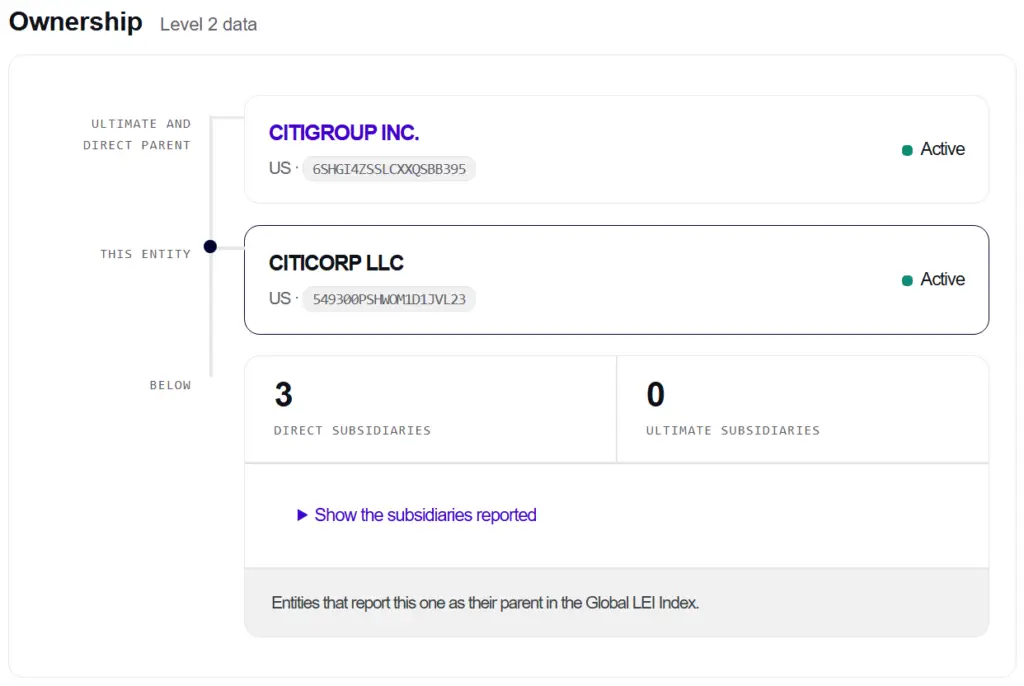
Level 2 data: Who is whom
- Direct parent: the immediate parent entity
- Ultimate parent: the top-level controlling entity
- Child entities: subsidiaries this organisation controls
Level 2 ownership data is valuable for corporate group analysis, KYB onboarding, and counterparty due diligence.
Understanding LEI Lookup Status and Entity Status in Search Results
ISSUED, LAPSED, and RETIRED. What each means
Issued
The LEI is active and has been renewed. Entity data is current and accepted for regulatory purposes.
Lapsed
The LEI has not been renewed by its renewal date. The data may be outdated. May not be accepted for regulatory reporting.
Retired
The entity has ceased operations (dissolved, acquired, or merged). The LEI is no longer active.
| Entity Status |
Active
The entity is legally registered and operational.
Inactive
No longer registered or operating. |
How is a Legal Entity Identifier record useful
LEI reference data used across financial services, compliance and KYB
Counterparty Verification
Verify the legal identity, address, and active status of a business before entering a financial transaction or contract.
KYC Compliance
Confirm corporate identity, ownership structure (Level 2), and incorporation status as part of AML and Know Your Customer processes.
Client Onboarding
Retrieve verified, registry-level entity data for client onboarding without manual lookups across multiple national registries.
LEI Status Check
Confirm whether a counterparty’s LEI is ISSUED, LAPSED, or RETIRED before a transaction or regulatory submission.
Regulatory Reporting
Lookup LEI codes required for transaction reports under MiFID II, EMIR, DORA, EU Instant Payments Regulation, and others.
Sanctions & Risk Screening
Cross-reference entity data as part of sanctions screening workflows using verified name, jurisdiction, and registration details.
What is the Global LEI Index?
The world's only open, globally standardised and regulated database of entity identifiers
The Global LEI Index, also called the Global LEI System, is the world’s only open, globally standardised, and publicly accessible database of entity identifiers.
It is maintained by the Global Legal Entity Identifier Foundation (GLEIF), a non-profit organisation established in 2014 by the Financial Stability Board and the G20. It holds more than 3.2 million LEI records covering organisations, funds and trusts in over 200 jurisdictions, and is updated several times a day.
Search results are returned live from the Global LEI Index. Full record pages are served from RapidLEI’s own synchronised copy of it, and every record states the date GLEIF last published it, so you can see how current the data is rather than take it on trust. Holding the record locally is what lets us read it whole and write a summary of it, instead of returning fields one query at a time.

Why use RapidLEI LEI Search?
The largest GLEIF-accredited LEI issuer, searching a database we contribute 490k LEIs to
RapidLEI is the largest GLEIF-accredited LEI Issuer globally, and one of only a small number of organisations accredited by GLEIF to issue and manage LEIs worldwide. We do not just search the Global LEI Index, we contribute directly to it, which is why data accuracy for the entities we manage is something we can stand behind.
- Free to use: no account or registration required
- Real-time data: results come from the Global LEI Index, and every record shows when GLEIF last published it.
- One search box: company name, LEI number, ISIN, or BIC, detected automatically
- Full LEI records: Level 1 reference data and Level 2 ownership data, explained rather than just stated
- Act directly from results: register, renew, transfer, or reactivated, where the record needs it
- 3.2 million+ records: 200+ jurisdictions
- GLEIF-accredited since 2018
- 450,000+ LEIs managed globally
| Feature | RapidLEI | GLEIF Search | Bloomberg LEI Search |
|---|---|---|---|
| Cost | Free | Free | Free |
| Account required | No | No | No |
| Search by company name | Yes | Yes | Yes |
| Search by ISIN | Yes | No | Yes |
| Search by BIC | Yes | No | Yes |
| Level 1 entity data | Yes | Yes | Yes |
| Level 2 ownership data | Yes | Yes | Yes |
| Plain-language record summary | Yes | No | No |
| Renew or transfer from results | Yes where the record needs it | No | No |
| Register a new LEI from results | Yes | No | No |
| eSealed LEI Certificate PDF | Yes | No | No |
| GLEIF-accredited LEI Issuer | Yes | Yes (GLEIF itself) | Yes |
Frequently Asked Questions
Common LEI Search questions
What is the difference between LEI search and LEI lookup?
They mean the same thing. An LEI lookup or an LEI search is a query to the Global LEI Index, the world’s open and globally standardised database of Legal Entity Identifiers, to find and verify information about a legal entity, fund or trust. You can search by company name, LEI number, ISIN or BIC to retrieve verified reference data including the entity’s legal name, address, registration status, LEI status and ownership structure. LEI search and LEI lookup mean the same thing and are used interchangeably.
How do I know whether an LEI can be relied on?
Three things decide it, and an LEI lookup shows all three. Whether the registration status is issued rather than lapsed or retired. Whether the entity itself is still active, because a valid LEI on a ceased organisation is a real and easily missed state. And whether the reference data was corroborated against a business register or supplied by the entity.
RapidLEI states the combined position in plain English on every record rather than leaving you to read four fields.
Can I use LEI lookup for KYB?
Yes, and the reference data suits it well: legal name, registered address, business register and registration number, incorporation jurisdiction, legal form and ownership structure, verified against authoritative registers rather than self-declared.
For KYB at volume, RapidLEI offers an API and the GLEIF Validation Agent framework, which lets a bank or fintech issue LEIs inside its own onboarding flow.
How do I find my own LEI number?
If your organisation has been issued an LEI but you do not know the number, enter your registered legal name in the search above. Your record will appear with its 20-character LEI code, registration status and entity details. You can also check correspondence from your LEI Issuer, regulatory filings, or your compliance team. If no results appear, your organisation may not yet hold an LEI.
How do I look up a company's LEI Number?
To look up a company’s LEI number, use the search box at the top of this page. Enter some or all of the company’s legal name in the search field and click Search. The results will display all matching LEI records. Click on any result to view the full LEI record including the 20-character LEI code, registered address, entity status, and ownership data. You can also search directly by ISIN or BIC code if you have those identifiers.
How do I check if a company has a valid LEI?
Enter the company name in the search box. Each result states in plain English whether the LEI is valid, lapsed or retired, gives its next renewal date and the days remaining, and names the LEI Issuer that maintains it. If no results are found, the company does not currently hold an LEI in the Global LEI Index.
What does "policy conforming" mean in LEI search results?
The Policy Conformity Flag is GLEIF’s indicator that a record meets its data quality standards, covering both the entity reference data and the completeness of the Level 2 ownership information. RapidLEI states it in words beneath each entity name, for example “Valid and conforming”.
A record can also be non-conforming, not applicable, or not yet assessed. Those are three different things, which is why we do not collapse them into a single tick or a blank space.
What are LEI corroboration levels?
Corroboration level describes how thoroughly a record’s entity data has been verified. Fully corroborated means it was validated against an authoritative business register. Partially corroborated means some of it was. Entity supplied only means the entity provided the data and it has not been independently checked. Fully corroborated records are preferred for KYB, KYC and regulatory reporting.
What information does an LEI lookup result show?
The results list gives the entity’s country, legal name, LEI, next renewal date with days remaining, and a plain line stating whether the LEI is valid, lapsed or retired and who maintains it.
Opening the record adds the full picture: registered and headquarters addresses, the business register and registration number, legal form, the LEI’s registration and renewal history, the register the data was last checked against and when, direct and ultimate parents or the reason none is reported, subsidiaries, and connected identifiers such as BIC, MIC, ISIN and OpenCorporates.
Can I search by ISIN or BIC instead of company name?
Yes. There is one search box and it works out what you have typed. A 20-character LEI, a 12-character ISIN and a company name are each recognised automatically.
BIC codes are handled slightly differently. Many company names share the shape of a BIC, so a BIC-shaped entry runs as a name search first, and falls back to a BIC lookup only if that returns nothing. You do not need to tell the tool which one you are using.
Can I search by the name of an Organisation, Trust or Fund?
Yes. Name search is the default and the most common way to use the tool. Enter all or part of the name in the search box. Funds and trusts are listed in the Global LEI Index on the same basis as companies.
Can I find a company's LEI if they don't know it themselves?
Yes. Search by the registered legal name. If the organisation has been issued an LEI it will appear in the Global LEI Index whether or not the organisation knows its own code. This is a routine step in counterparty verification and compliance checks.
Is LEI lookup free?
Yes. The Global LEI Index is publicly accessible and RapidLEI’s lookup connects to it and retrieves and decodes records at no charge, with no account or registration. There is no cost to look up, view or export an LEI record.
What is the Global LEI Index and who maintains it?
It is the world’s only open, standardised database of Legal Entity Identifiers, maintained by the Global Legal Entity Identifier Foundation (GLEIF), a non-profit established in 2014 by the Financial Stability Board and the G20. It holds more than 3.2 million records covering organisations in over 200 jurisdictions and is updated several times a day. GLEIF’s own search tool and RapidLEI’s lookup both draw on the same index; RapidLEI additionally interprets the record and lets you act on it.