

Legal Entity Identifiers aren’t a compliance cost. They’re a condition of capital being deployable.
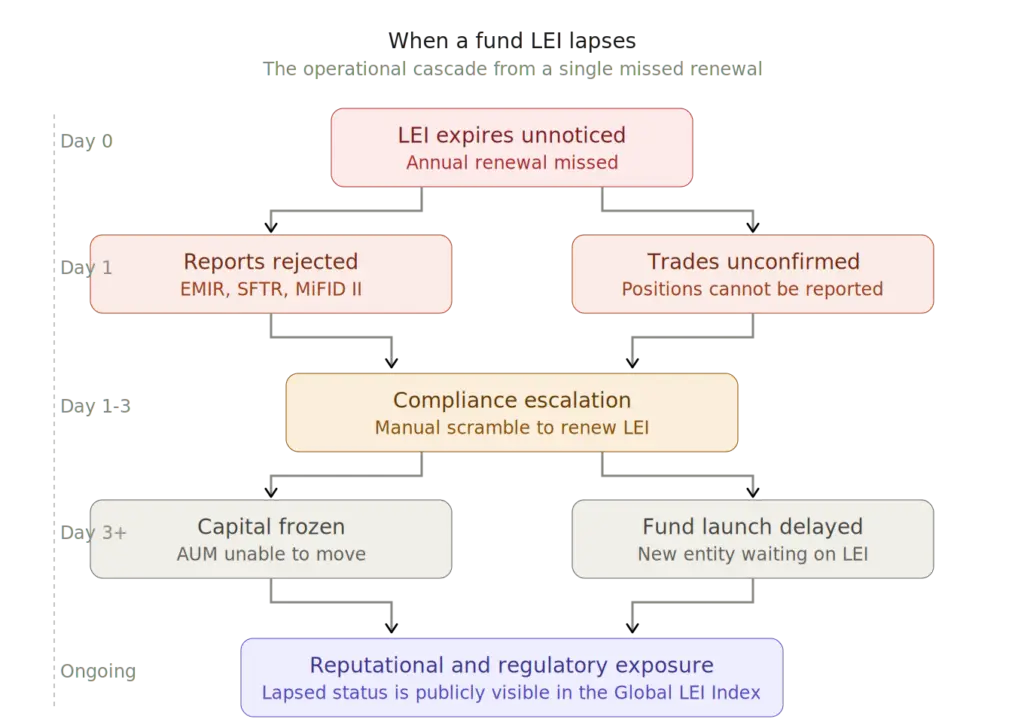
It’s Monday morning. An operations analyst at a mid-sized European asset manager opens a rejection notice from a trade repository. Three EMIR derivatives reports have been bounced. The reason: lapsed LEI Numbers on three fund entities.
The trades behind those reports can’t be confirmed. The portfolio manager who executed them is sitting on positions that can’t be reported, which means, under the regulatory framework, they shouldn’t have been executed at all. Compliance escalates. The fund administrator scrambles to renew the LEIs. It takes hours, sometimes longer if the underlying data needs updating. Capital that was supposed to be working is sitting still.
We have seen this. It’s not an edge case and it’s entirely preventable.
LEI sits in the infrastructure layer
Asset managers invest heavily in what drives returns: market analysis, portfolio construction, risk. The infrastructure behind it gets less attention, until it breaks.
LEI belongs in that same layer. Under MiFID II, EMIR, AIFMD, SFTR, and others, a valid LEI is a precondition for a legal entity to participate in reportable financial transactions. No LEI, no trade. A fund without an active LEI can’t have its trades reported. A counterparty without one can’t appear in a transaction report. The consequence isn’t a fine. It’s a blocked transaction.
Yet in many firms, LEI management sits in no-man’s-land between compliance and operations. Compliance sets the rules but doesn’t manage the identifiers. Operations manage trade flow but treats LEI as someone else’s problem. The result: LEI coverage tracked in spreadsheets, renewed reactively, noticed only when something breaks.
The NAV comparison
Net Asset Value (NAV) is the total value of a fund’s assets minus its liabilities. It’s calculated daily, sometimes more frequently, and it’s how investors know what their holdings are worth. It determines the price at which fund shares are bought and sold. Every asset manager maintains rigorous, real-time control over NAV because the alternative is operationally unacceptable.
LEI status plays a comparable role in the infrastructure stack, but it rarely gets the same attention. Every fund, trust, SPV, and counterparty entity in your portfolio holds capital that can only move if the LEI is active. A lapsed LEI doesn’t destroy the capital, but it does immobilise it. The regulatory plumbing that allows those assets to participate in the financial system has a broken link. Trades can’t be reported. Derivatives submissions get rejected. The capital is locked in place until someone fixes the identifier.
NAV and LEI both serve as preconditions for a fund to function in the market. Neither is “set and forget”. One just gets treated that way. The difference is that NAV is monitored in real time by dedicated teams with purpose-built systems. LEI status is maybe checked once a year at best.
Scale makes this a portfolio problem
For example, let’s take a typical asset manager running 150 fund structures across multiple jurisdictions. Each fund holds its own LEI. The management company holds one. Key counterparties (prime brokers, custodians, administrators) each hold LEIs that affect the manager’s ability to report and trade.
What you actually have is a portfolio of identifiers, each with its own expiry date, data issues, and renewal cycle. If 2% lapse in a given quarter, that’s three funds unable to report derivatives trades, unable to appear in SFTR submissions, and potentially facing delays in cross-border transactions.
Scale that to a larger operation (500 fund entities, complex umbrella structures, overlapping jurisdictional requirements) and the LEI portfolio becomes a genuine operational risk factor. No single LEI is difficult to manage. The problem is volume because, at scale, gaps don’t look like gaps until something fails.
What we mean by “Keep AUM in Motion”
When every entity in your portfolio holds a valid, accurate LEI, capital flows. Trades can execute, onboarding can complete and cross-border transactions can clear without manual intervention.
When LEI coverage has gaps (lapsed identifiers, missing registrations on new fund launches, stale data from restructurings) that flow gets interrupted. Not all at once but in small, costly, reputation-damaging ways that compound over time.
The managers who handle this well don’t treat LEI as a compliance task that happens once a year. They treat it as a managed portfolio: monitored continuously, renewed proactively, wired into the same lifecycle workflows that govern every other part of fund operations.
What the firms that get LEI management right have in common
They have real visibility, not a spreadsheet someone updates once a quarter. One view showing the LEI status of every entity in the book: active, expiring, lapsed, missing. They know what’s expiring in 30, 60, 90 days. They don’t find out about a lapsed LEI from a rejected trade report.
Someone actually owns it, and someone is accountable for LEI portfolio health. It isn’t lost somewhere between compliance and ops.
They remove the annual renewal problem entirely. Multi-year LEI plans with automated renewal take out the single biggest cause of lapse: the annual renewal nobody processed. API integration with trade and onboarding workflows catches gaps before they cause problems downstream.
They treat LEI like any other lifecycle dependency: a new fund needs a new LEI, and a restructure needs a data review. A company wind down needs an LEI to be retired. There are no exceptions that create undue risk.
A different conversation about cost
The cost of managing LEI Numbers properly is trivial relative to the AUM it protects. The cost of getting it wrong (blocked trades, rejected reports, delayed launches, manual workarounds, reputational exposure) is out of all proportion to the cost of preventing it.
This isn’t a cost question. It’s a control question. Either you use a tool such as EnterpriseLEI to manage LEI as infrastructure and keep your AUM in motion, or you accept that, at times, it won’t move at all.
Keeping AUM in motion depends on every fund holding an active LEI. See fund LEI registration and multi-year auto-renewal.
Talk to RapidLEI about consolidating, managing and keeping your LEI Numbers active.